
Bill Gates is to Donate his $100B Wealth by 2045
Bill Gates pledges to give away 99% of his $107B wealth through the Gates Foundation over the next 20 years, planning to shut it down by 2045.
 Utej
Utej
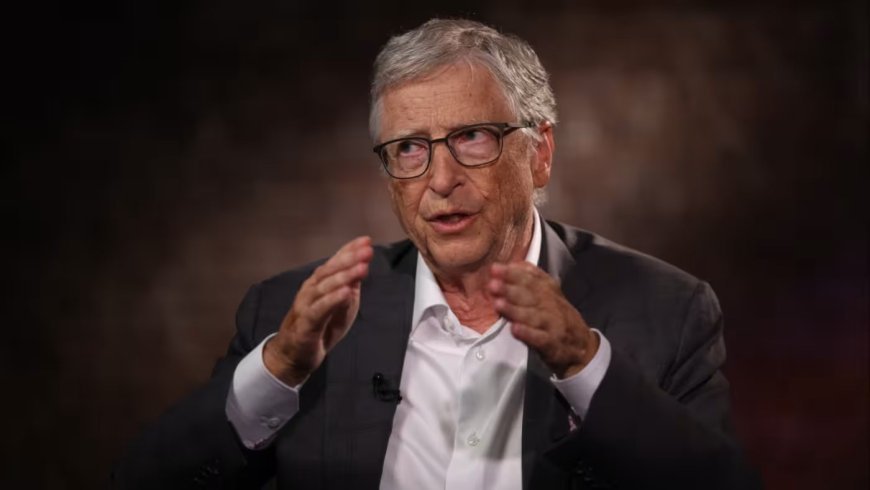
He Doesn't Want to Die Rich: Why Bill Gates Is Giving Away Everything — and the Clock Has Started
There is a line that Bill Gates wrote in a blog post on 8 May 2025 that cuts through everything else around it. Not because it is the most technically significant sentence in the announcement — there were bigger numbers, larger stakes, more complicated institutional implications — but because it is the most nakedly human one.
"People can say whatever they want about me when I'm gone, but I'd hate for "he died rich" to be the thing I'm remembered for."
That is not the language of a press release. That is not a line written by a communications team and cleared by legal. That is a 69-year-old man, sitting with his own mortality, deciding what he wants his life to have meant — and then doing something about it with enough specificity and enough money that nobody can accuse him of just saying nice things.
What he announced was this: he will donate 99% of his fortune — currently estimated at $107 billion, though the actual number being deployed over 20 years could be closer to $200 billion once investment returns are included — to the Bill & Melinda Gates Foundation. And on 31 December 2045, the foundation will close its doors permanently. Two decades. A specific end date. A commitment that cannot be quietly walked back.
For anyone who follows philanthropy seriously, this was a landmark moment. For anyone who does not follow philanthropy at all, it was still a remarkable thing to sit with: One of the richest men the world has ever seen has made an unusual choice: to give away almost all of his wealth and ensure that the institution he built completes its work rather than carrying on for another hundred years.
After a Year of Milestones, He Found Himself Looking Ahead
The timing of Gates' announcement is not accidental. He said so himself, and the specific details he cited are worth dwelling on.
2025 is the Gates Foundation's 25th anniversary — a natural moment of reflection on what has been built and what remains to be done. Microsoft, the company Gates co-founded in a New Mexico garage in 1975 with Paul Allen, turns 50 this year. Gates himself turns 70 in October. And his father — Bill Gates Sr., the lawyer and philanthropist who helped shape the foundation's early direction and whose own values of public service and civic responsibility were deeply influential on his son — would have turned 100 this year.
Gates Sr. died in September 2020. His influence on the foundation was formative. He believed, simply and without apology, that those who had been given much owed something substantial back to the world that had given it to them. His son has spent 25 years acting on that belief. The announcement in 2025 was, in a way, a final honouring of what his father stood for — not a small, comfortable gesture but a total, irreversible one.
"According to Gates, the decision comes after spending time thinking deeply about the future and the legacy he hopes to leave behind . "As the foundation marks its 25th anniversary, this year also brings several deeply personal milestones. Among them is the fact that my father, who helped me start the foundation, would have turned 100.; Microsoft is turning 50; and I turn 70 in October."
When someone lists those milestones in a single breath alongside the announcement that they are giving away everything, you believe them.
Looking Beyond the Number: What $200 Billion Represents
To understand the scale of what Gates has committed, it helps to put it in context — both financial and historical.
The Gates Foundation currently has an endowment of $77 billion, built from contributions from Gates himself, from Melinda French Gates (his ex-wife and co-founder), and from Warren Buffett, who has been donating enormous amounts of his Berkshire Hathaway stock to the foundation for years. Gates' additional pledge of 99% of his personal fortune — worth approximately $107 billion at the time of the announcement — means the foundation will have access to roughly $200 billion in total new philanthropic capital over the next 20 years.
To put that in historical perspective: this pledge outpaces the contributions of John D. Rockefeller and Andrew Carnegie, the two great American philanthropists of the late 19th and early 20th centuries, when adjusted for inflation. The only pledge that might exceed it, depending on stock market performance, is Warren Buffett's commitment to donate his entire fortune — currently estimated at around $160 billion by Forbes. These are the two largest personal philanthropic commitments in recorded human history.
The foundation has already contributed more than $100 billion to global causes since it was founded in 2000 — to global health initiatives, vaccine access in low-income countries, educational equity programmes, agricultural research, and poverty alleviation efforts across the developing world. The organisation estimates that these contributions have helped save 82 million lives through its efforts to fight AIDS, malaria, and tuberculosis, and through improving access to vaccines in nations that otherwise could not afford them.
The $200 billion committed for the next 20 years will roughly double that impact. It is, in Gates' own words, "kind of thrilling to have that much to be able to put into these causes."
That sentence — "kind of thrilling" — is also worth sitting with. Not the language of obligation or sacrifice. The language of someone who genuinely cannot think of a better use of the resources he has accumulated. That psychological shift — from acquiring to deploying — is, perhaps, the most interesting part of the Gates story.
Andrew Carnegie and the Essay That Changed How Gates Thinks About Wealth
Gates is an avid reader. He is famous for it — the annual book lists, the weeks-long reading retreats, the library built into his home. And in his blog post announcing the 2045 commitment, he specifically cited an essay written in 1889 by Andrew Carnegie that he says shaped his thinking about what wealthy people owe the world.
Carnegie's "The Gospel of Wealth" is not subtle. It argues that men who accumulate great fortunes in a competitive society have a moral obligation to administer that wealth for the benefit of the community — during their lifetimes, not after. Carnegie's exact formulation was blunt: "The man who dies rich dies disgraced." He was not speaking abstractly. He spent the last 18 years of his life giving away roughly $350 million (billions in today's money), funding libraries, universities, scientific institutions, and the Carnegie Hall that still bears his name in New York.
Gates read Carnegie's essay and heard something that resonated. He wrote: "There are too many urgent problems to solve for me to hold onto resources that could be used to help people. That is why I have decided to give my money back to society much faster than I had originally planned."
The phrase "much faster than I had originally planned" is important. The original structure of the Gates Foundation included a provision that it would operate for 20 years after Gates' death before closing — the idea being that its work would outlast him by a generation. The new commitment accelerates that entirely. Rather than the foundation running until sometime in the 2060s or 2070s, it will now close on a specific date he has chosen: 31 December 2045, when Gates will be 89 years old.
He explained the reasoning for a defined endpoint: "I think 20 years is the right balance between giving as much as we can to make progress on these things and giving people a lot of notice that now this money won't be here." That last clause is significant. By announcing the closure date now, he is telling every organisation that depends on Gates Foundation funding to plan for a world without it — to build sustainability into their own models rather than expecting his money to be available indefinitely.
What the Money Will Actually Do
The foundation has been clear about where the next $200 billion will go. The focus areas are not new — they are the issues the Gates Foundation has been working on for 25 years — but the scale and the urgency are both escalating.
Global health remains the central priority. Eradicating preventable deaths in childbirth — particularly among mothers and newborns in sub-Saharan Africa and South Asia — is one of the foundation's most consistent and most impactful areas of work. The diseases that Gates has been fighting longest — malaria, tuberculosis, HIV/AIDS, polio — have seen extraordinary progress through foundation-funded research, vaccine development, and distribution infrastructure. The goal for the next 20 years is to complete that progress, not merely maintain it.
The foundation's work in agricultural development in low-income countries — funding new crop varieties, improving soil health, and building market access for smallholder farmers — represents a different kind of impact: not the dramatic, measurable kind of "lives saved from disease" but the quieter, equally significant kind of "families lifted permanently out of food insecurity."
Education in the United States has been a third strand. The foundation has funded teacher effectiveness initiatives, Common Core curriculum development, and more recently, the use of AI tutoring tools to personalise learning for students who lack access to quality teaching. These investments have been more contested domestically than the global health work — education reform is politically complicated in America in a way that vaccinating children against malaria is not — but they represent Gates' genuine conviction that educational equity is a prerequisite for a functioning democracy.
There is also the dimension of climate change and clean energy, which the foundation has engaged with increasingly through Gates' separate investment vehicle Breakthrough Energy. While not technically a Gates Foundation priority in the same way as health and education, the climate work reflects the same underlying belief: that the most powerful deployment of private capital is toward problems where markets have failed and governments have not filled the gap.
The Political Context: Why This Announcement Landed the Way It Did
Gates did not announce his accelerated giving plan in a vacuum. He announced it in May 2025, in the specific political and institutional context of the United States under the Trump administration — a context in which federal funding for global health programmes had been dramatically reduced, in which USAID had been largely dismantled, and in which the role of government in addressing global poverty and disease was being actively retreated from.
When Gates spoke to NPR about the announcement, he connected the dots explicitly: his philanthropic efforts had taken on a new sense of urgency "in this current political moment." The reduction of US government support for the global health infrastructure that the Gates Foundation had helped build over 25 years created a gap that private philanthropy could not fully fill — but that the Gates Foundation would try harder than ever to help bridge.
This is not a neutral political observation. It is a billionaire's response to the withdrawal of state capacity from problems he cares about deeply. Reasonable people disagree about whether private philanthropy is the right response to that withdrawal — whether it reinforces a model where the ultra-wealthy substitute for democratic governance, or whether it is a pragmatic response to suffering that cannot wait for political cycles to turn.
Gates himself is not naive about this tension. He has written and spoken about the limitations of philanthropy and the necessity of government action at scale. But his position, plainly stated, is: in the absence of that government action, these people are dying, and he has the resources to help, and he is going to use them.
The Giving Pledge: A Movement That Started Here
The announcement cannot be separated from the broader movement that Gates helped start. In 2010, Gates and Warren Buffett co-founded The Giving Pledge — an initiative encouraging the world's wealthiest individuals and families to commit the majority of their wealth to philanthropic causes. As of 2025, more than 240 signatories from 30 countries have joined the Pledge, collectively committing hundreds of billions of dollars.
The Giving Pledge is not a legal contract. There is no enforcement mechanism. The commitment is reputational and moral, not legally binding. Critics have noted that many signatories have given much less than their pledges implied. But as a cultural and normative shift within the ultra-wealthy community — a shift away from the default assumption that great fortunes are inherited and accumulated across generations, and toward the expectation that they are given away during the accumulator's lifetime — it has had measurable effect.
Gates' 2025 announcement is the most dramatic example yet of the Pledge's intent being honoured at full scale. Not "I intend to give most of my wealth" but "here is a specific date, a specific institution, a specific closure plan, and a specific number — $200 billion — and I am putting it in writing."
Warren Buffett, who stepped back from the Gates Foundation board in 2021 but has continued to donate his fortune to a range of foundations, announced his own retirement shortly after Gates' announcement, having similarly committed to distributing everything. The two men who started the Giving Pledge are both, in their own ways, trying to finish what they started.
What the Closure of the Foundation Actually Means
The decision to close the Gates Foundation on 31 December 2045 deserves careful reading, because it is easy to misunderstand.
Closing the foundation does not mean the work it funded will disappear. The organisations, research institutions, health systems, and governments that have been supported by Gates Foundation grants over 25 years have built their own capabilities — some more robustly than others, but many of them now operating with endowments, partnerships, and institutional knowledge that exist independently of the foundation's continued support.
The closure means something different: that Gates is explicitly choosing not to create a dynasty of wealth and institutional influence. The original plan — foundation closes 20 years after his death — was still a form of the founder's intentions outlasting the founder. The 2045 deadline is a different choice: to complete the mission within a defined period, deploy the resources with urgency rather than caution, and then let the institution go.
"Spending down his fortune will help save and improve many lives now, which will have positive ripple effects well beyond the foundation's closure," the AP reported Gates saying. The present tense matters. Not eventually. Not after various procedural safeguards and multigenerational endowment management. Now.
A Final Word: The Weight of the Decision
Sometime in October 2025, Bill Gates will turn 70. He will do so as a man who has publicly committed to giving away virtually everything he has accumulated in a lifetime of exceptional professional success, by a specific date he has chosen, through an institution he will then close.
That is a specific kind of courage — not the dramatic kind, not the kind that looks good in a film, but the quieter kind that involves sitting with your own legacy and deciding what you want it to be while you still have the chance to shape it.
The Carnegie essay Gates cited ends with a thought that has apparently stayed with him for years: "The man who dies rich dies disgraced." Carnegie wrote those words 136 years ago. They have been cited, quoted, and argued over ever since. Mostly by people who did not act on them.
Gates is acting on them. With a date. With a number. With the weight of $200 billion and 20 years behind it.
However history ultimately judges his choices — and there will be genuine debate about the priorities, the methods, and the politics of the Gates Foundation's work — no one will be able to say he died with his resources unused.