
Cannes 2025: Highlights and Indian Cinema Representation
Explore the highlights of the 78th Cannes Film Festival, featuring India's significant presence with Payal Kapadia on the jury, a diverse film lineup, and the festival's engagement with global issues.
 Utej
Utej

Cannes 2025: Where Cinema Fights Back, India Rises, and the World Watches
nside the 78th Cannes Film Festival: The Moments, the Debates, and India's Growing Presence
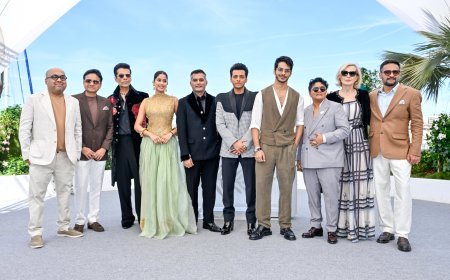
There is a particular quality to the light on the Croisette in May. Anyone who has been to Cannes will tell you this — the way the Mediterranean afternoon filters through the palm trees onto the long boulevard that runs beside the sea, the white facades of the grand hotels catching the gold of it, the whole scene arranged as if cinema itself had designed the backdrop for its own celebration. It is, quite deliberately, the most cinematic place on earth during the most cinematic two weeks of the year.
The 78th Cannes Film Festival — running from May 13 to 24, 2025 — is everything that description promises, and considerably more complicated. Because Cannes has never been purely about beauty. It has always been about argument: about what cinema is, what it should be, who gets to make it, who gets to be seen, and what it means when the most powerful countries in the world decide that art is a threat rather than a gift.
This year, those arguments are louder than ever. And the voices making them are more diverse, more urgent, and more interesting than they have been in a long time.
The Stage: Why Cannes Still Matters
Before we go deeper, it's worth asking a question that is sometimes posed but rarely answered well: in 2025, with streaming platforms producing more content than anyone can watch, with film festivals proliferating in every major city on earth, with the entire history of world cinema available on a smartphone — why does Cannes still matter?
The answer is not really about the awards, though the Palme d'Or remains the most prestigious prize in cinema. It's not about the parties, though the parties are legendary. It's not even purely about the films, though the quality of the official selection is consistently extraordinary.
Cannes matters because it is the one moment in the year when cinema is treated, collectively and publicly, as a serious thing. When directors whose work might otherwise circulate only within festival circles for a few months are suddenly on the front pages of global newspapers. When a film from Iran, or South Korea, or the Democratic Republic of Congo stands beside the latest work from a celebrated American or French director and is judged by the same standard: is this good? Does it matter? Does it see something true?
In a world increasingly organised around algorithms that recommend what you've already seen, Cannes is an act of deliberate disruption. It says: here are things you didn't know you needed to see. Pay attention.
The 78th edition has said this with particular force.
Why India's Strong Showing at Cannes Is the Result of Years of Progress
Let's begin where the most personally resonant story of this year's festival begins: with India.
The country's relationship with Cannes is long and complex. Satyajit Ray premiered films here. Indian cinema has been celebrated in the Cannes Classics section for decades. But there has often been a sense, in the broader conversation, that India was a presence at Cannes rather than a force — represented, acknowledged, respected, but not yet central.
2025 feels different. Genuinely different.
Payal Kapadia is sitting on the main competition jury.
To understand why this is significant, remember what Kapadia accomplished last year. Her film All We Imagine as Light — a quiet, luminous film about two nurses in Mumbai, their lives, their loneliness, their longing — won the Grand Prix at Cannes 2024. This was not a minor achievement. The Grand Prix is the second-highest prize in the festival's official competition. For an Indian filmmaker to win it, with a film set entirely in India, in Malayalam and Hindi, speaking from and about a specific Indian experience, was a statement.
It said: this is not regional. This is universal. This is cinema.
Having Kapadia return to Cannes in 2025 not as a filmmaker seeking validation but as a judge bestowing it — sitting at the same table as Juliette Binoche, Halle Berry, Jeremy Strong — is the natural next chapter of that story. She is not there to represent India in a token sense. She is there because she has earned it, because her artistic vision has been recognised at the highest level, and because her presence on the jury changes the conversations happening inside that room.
The films that will win prizes at Cannes 2025 will be partly shaped by a filmmaker from India who made a film about nurses in Mumbai. That is not a small thing.
But India's presence at this year's festival extends beyond Kapadia.
The Cinéfondation section — dedicated to student films from around the world — includes A Doll Made Up of Clay, produced by the Satyajit Ray Film and Television Institute (SRFTI) in Kolkata. The Cinéfondation is where careers begin. It is where the Cannes selection committee looks for what is coming — the sensibilities, the preoccupations, the visual languages that will define the next generation of international cinema. When a film from SRFTI earns a place in a prestigious Cannes section, it reflects the growing quality and international recognition of India's film training institutions.
And then there is the Cannes Classics section, which this year includes a restored print of Satyajit Ray's Days and Nights in the Forest from 1970. Ray at Cannes is almost ritual at this point — his films have been screened, celebrated, and discussed at the festival for over half a century. But the restoration and re-screening of Days and Nights in the Forest in 2025 is a particular kind of honour. It says that this film — not one of Ray's most internationally famous, but one of his most psychologically intricate — deserves to be seen again, by new eyes, on the largest possible screen.
Between Kapadia's jury seat, the SRFTI student film, and the Ray restoration, India is present at Cannes 2025 in three different registers simultaneously: the present, the future, and the past. That is not an accident. That is a cultural moment.
The Competition: What's Actually Playing for the Palme
The main competition at Cannes 2025 features 19 films, and the lineup reads like a wishlist assembled by someone who genuinely loves cinema in all its variety.
Julia Ducournau returns with Alpha. Ducournau won the Palme d'Or in 2021 with Titane — a film so extreme, so deliberately transgressive, that the industry spent weeks debating whether the jury had lost their minds or seen the future. The answer, as it turned out, was both. Titane has only grown in stature since its premiere. What Alpha will bring is one of the festival's central questions.
Lynne Ramsay's Die My Love is perhaps the selection that has generated the most anticipatory excitement among film critics and serious cinemagoers. Ramsay — the Scottish director behind We Need to Talk About Kevin and You Were Never Really Here — makes films with a ferocity and visual intelligence that places her among the finest directors working anywhere. Her films are difficult and unforgettable in equal measure. Die My Love is her first film since You Were Never Really Here in 2017, an eight-year wait that has done nothing to diminish the anticipation.
Ari Aster's Eddington represents a different kind of anticipation. Aster — the director of Hereditary and Midsommar and the surrealist epic Beau Is Afraid — has established himself as the most formally ambitious filmmaker working in American genre cinema. Eddington is apparently a Western, which is either a complete departure or, knowing Aster, a complete coherence. The official competition will find out.
Wes Anderson brings The Phoenician Scheme to competition — Anderson at Cannes is always a particular event, because his films polarise the critical establishment in ways that few directors can manage. There are people who believe he is the most distinctive visual stylist of his generation. There are people who believe he has been making the same film for 25 years. Both groups will see The Phoenician Scheme and have their views sharpened.
Jafar Panahi's It Was Just an Accident carries a weight that goes beyond its artistic qualities. Panahi is an Iranian filmmaker who has spent years under a travel ban and filmmaking prohibition imposed by the Iranian government, making films anyway, smuggling them out of the country, having them screened at international festivals while he remained unable to attend. His presence in the competition — in whatever form that takes — is a statement about the relationship between art and political repression that Cannes has always been willing to make.
The Dardenne Brothers with The Young Mother's Home bring the Belgian masters of social realism back to a festival they have won twice, with the absolute commitment to depicting lives at the economic and social margins that has defined their entire career. The Dardenne brothers at Cannes is one of cinema's most reliable forms of moral seriousness.
This is a competition that refuses to settle for the comfortable or the familiar. It is asking its audiences to engage, to be challenged, to sit with things that resist easy resolution.
The Jury: A Room That Reflects the World
Juliette Binoche presiding over the main competition jury is a choice that makes immediate sense. Binoche is one of the greatest film actors alive — she has worked with Kieślowski, Haneke, Kiarostami, Godard, Abbas Kiarostami, Claire Denis, and dozens of other filmmakers whose names represent the entire spectrum of international cinema. She doesn't just know good cinema. She has lived inside it for four decades. Her aesthetic judgments come from a place of extraordinary depth.
Surrounding her is a jury of unusual breadth.
Halle Berry brings the perspective of an actor who has navigated Hollywood at its most commercial and, in recent years, moved decisively toward more personal, risk-taking creative work. Jeremy Strong — the Succession actor who has become a cultural phenomenon for his commitment to psychological realism in performance — brings an actor's understanding of interiority, of what it costs to fully inhabit a character.
Payal Kapadia we have already discussed. Leïla Slimani, the French-Moroccan author, brings a literary and North African perspective. Dieudo Hamadi from the Democratic Republic of Congo — one of Africa's most important documentary filmmakers — ensures that the jury's frame of reference extends well beyond Europe and North America. Hong Sang-soo from South Korea, one of the world's most prolific and formally distinctive filmmakers, and Carlos Reygadas from Mexico, whose films exist at the absolute edge of what narrative cinema can do, complete a jury that seems designed to produce interesting, unpredictable, possibly contested results.
A jury this diverse doesn't agree easily. The conversations happening in that deliberation room will be genuine arguments — about what cinema is for, what it should prioritise, what kind of achievement deserves the highest recognition. That friction is not a problem. It's the point.
Tom Cruise on the Croisette — and What It Meant
The red carpet moment that generated the most global attention — at least in terms of sheer star power — was Tom Cruise's arrival at Cannes to promote Mission: Impossible – The Final Reckoning.
Cruise at Cannes is always a spectacle, and this year was no exception. The promotional campaign for what may be his final Mission: Impossible film has been built around a series of increasingly audacious real-world stunts, and the Cannes appearance was consistent with that approach. Standing on the nose of a WWII-era biplane in flight for the film's promotional materials, Cruise arrived on the Croisette as a living embodiment of old-school movie stardom — the kind that involves actually doing dangerous things rather than having a digital artist do them for you.
There's something slightly unusual about the presence of a major Hollywood franchise film at Cannes, a festival whose identity has historically been defined by a certain suspicion of commercial blockbuster cinema. But Mission: Impossible has always occupied an interesting position — it is commercially enormous and also, in its best moments, genuinely cinematic in ways that most action franchises are not. McQuarrie's direction, Cruise's commitment, the practical stunt philosophy — these are the choices of filmmakers who care about cinema as an art form, not just as a delivery system for IP.
Andie MacDowell's appearance at the premiere in a classic black tuxedo — confident, glamorous, entirely her own — was one of those red carpet moments that transcends fashion to become a statement. MacDowell has spent years navigating an industry that tends to sideline women of a certain age, and her embrace of what she has called her "silver fox" identity, on one of fashion's most visible stages, is the kind of quiet defiance that resonates far beyond the Croisette.
Halle Berry, dual-roled as both jury member and red carpet presence, led with a black and white ensemble that reminded everyone that when it comes to Cannes fashion, the classics hold.
Robert De Niro, the Honorary Palme, and the Speech Nobody Will Forget
The most politically charged moment of Cannes 2025 — and in a festival that has always been a space for political speech, this is saying something — came when Robert De Niro received the honorary Palme d'Or.
Honorary Palmes are given to figures whose contribution to cinema is considered sufficient to merit recognition beyond any single film. De Niro's career speaks for itself: Taxi Driver, Raging Bull, The Godfather Part II, Heat, Goodfellas, The Deer Hunter — a filmography that represents some of the greatest screen acting in the history of the medium. The honorary award was, in itself, an entirely appropriate recognition.
What De Niro did with the acceptance speech was something else.
He used the platform to deliver a fierce defence of art and a pointed criticism of President Donald Trump, specifically targeting the administration's proposed 100% tariff on international films — a policy that, if implemented, would have profound consequences for the global film industry and represents an extraordinary degree of cultural protectionism.
De Niro called Trump a "philistine president" — a phrase that captured immediate international headlines — and spoke about the responsibility of artists to resist cultural narrowing, to insist on the value of exchange and diversity, to refuse the reduction of cinema to a commercial transaction measured in trade deficits.
The speech landed differently depending on who was in the room. In a festival audience that skews international and culturally progressive, it received an enthusiastic response. In the broader political conversation, it immediately became another data point in the ongoing debate about whether celebrities should use award platforms for political speech.
But here's what's worth saying: Cannes has always been a political space. The festival was cancelled in 1968 by filmmakers who supported the student uprising in France. It has screened films from politically repressed filmmakers, given platforms to directors whose governments wanted them silenced, and consistently refused to pretend that cinema exists in a vacuum sealed from the world.
De Niro's speech was not a departure from Cannes's identity. It was an expression of it.
The 100% tariff on international films that he referenced is, genuinely, a serious issue. If such a tariff were implemented, it would dramatically affect the economics of international co-productions, reduce the number of foreign films available to American audiences, and signal a retreat from the kind of cultural exchange that festivals like Cannes exist to facilitate. Whether you agree with De Niro's characterisation of the president or not, the underlying policy concern is legitimate and the platform was appropriate.
What Cannes 2025 Is Saying About Cinema
Step back from the individual stories — the Indian triumph, the political speech, the competition films, the red carpet moments — and Cannes 2025 is making a coherent argument about what cinema is and what it's for.
It's arguing that cinema is a global conversation, not a national product. The jury alone represents nine countries across four continents. The competition films come from France, Germany, the United States, Iran, Belgium, and beyond. The Cinéfondation includes student work from India. The Classics section reaches back to 1970s Bengal. This is cinema as a shared human inheritance, not a collection of national industries competing for market share.
It's arguing that diversity of perspective is not a gesture but a necessity. A jury dominated by one nationality, one gender, one cultural tradition will systematically miss things. The conversations happening in that deliberation room are richer and more productive because the people having them have arrived from genuinely different places — aesthetically, culturally, experientially.
And it's arguing, most urgently, that cinema matters in exactly the moments when political forces are trying to diminish it. The tariff policy that De Niro addressed is not an isolated decision. It reflects a broader tendency — visible in various forms across multiple countries — to treat culture as a luxury, a distraction, or worse, a vector of foreign influence to be quarantined.
Cannes 2025 is saying: no. Cinema is not a luxury. It is how human beings understand each other across the distances of language, geography, and lived experience. It is how an audience in Mumbai can feel the texture of life in Seoul, or Tehran, or Kinshasa. It is how Satyajit Ray speaks to people who have never set foot in Bengal and never will.
Diminish that and you diminish something fundamental about what it means to be human in a shared world.
The Palme d'Or Question
Who will win?
Nobody knows, and that uncertainty is part of what makes Cannes exciting year after year. A jury this diverse, presided over by Juliette Binoche, with Payal Kapadia at the table and Hong Sang-soo and Dieudo Hamadi alongside her — the result is genuinely unpredictable in the best possible way.
The serious contenders, based on early industry conversation, include Lynne Ramsay's Die My Love, Julia Ducournau's Alpha, and Jafar Panahi's It Was Just an Accident. But the history of Cannes is littered with predictions that didn't survive contact with the actual jury, and films that nobody expected to win the Palme have done so more than once.
The festival runs through May 24. The conversations are happening. The films are being watched, debated, felt. And somewhere in a deliberation room on the Côte d'Azur, nine people from nine different countries are arguing, respectfully or otherwise, about what is the best film they have seen.
An Invitation
If you have never watched a Cannes competition film, this year is a good year to start paying attention.
Not because the films are easy or comfortable — they won't all be. Not because you'll love everything the jury loves — you might not. But because the act of encountering cinema that you wouldn't have found without this festival, made by someone whose world is genuinely different from yours, is one of the most fundamentally expanding experiences that art can offer.
Payal Kapadia made All We Imagine as Light from within a specifically Indian experience and placed it on the Cannes stage where the whole world could encounter it. The student filmmaker from SRFTI making A Doll Made Up of Clay is reaching toward the same thing. Satyajit Ray reached toward it in 1970 and is reaching still.
Cinema at its best is that reach. And Cannes, at its best, is where that reach is honoured.
The 78th edition is doing exactly that.
The 78th Cannes Film Festival runs from May 13 to 24, 2025. The Palme d'Or and all major competition awards will be announced at the closing ceremony on May 24. Jury President: Juliette Binoche. Indian jury representative: Payal Kapadia.