

India Becomes World’s 4th Largest Economy, Surpasses Japan
India has overtaken Japan to become the 4th largest economy in 2025, driven by strong growth, reforms, and rising global influence.
 Utej
Utej

## India Is Now the World’s Fourth-Largest Economy — Here’s Why It Matters
For decades, India was often described as a nation with enormous potential. Today, that potential is increasingly becoming reality.
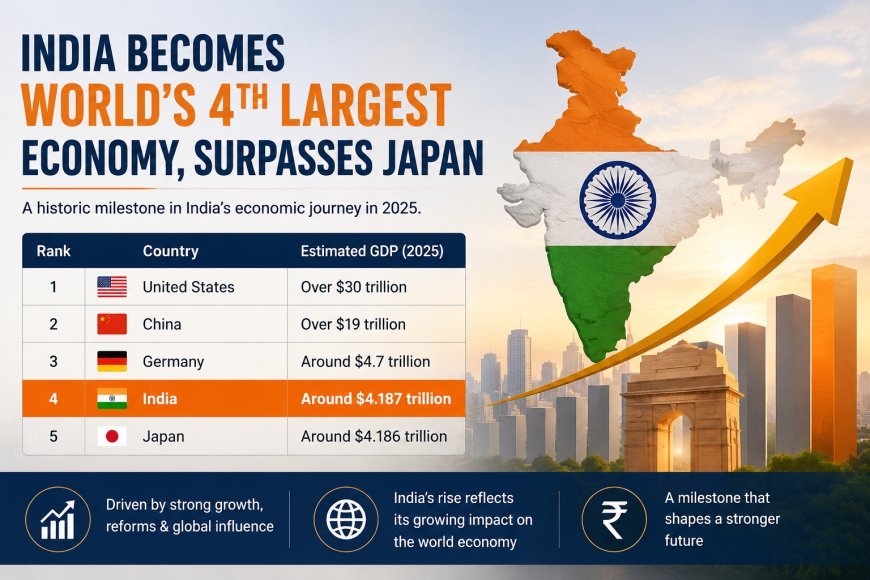
In a landmark development for the country's economic journey, India has officially overtaken Japan to become the world's fourth-largest economy based on nominal Gross Domestic Product (GDP). According to the latest estimates from the International Monetary Fund (IMF), India's economy is projected to reach approximately $4.187 trillion in 2025, narrowly surpassing Japan's estimated GDP of $4.186 trillion.
While the numerical difference may appear small, the significance of this achievement is enormous. It represents far more than a shift in rankings. It signals India's growing influence in global markets, its rising importance in international trade, and the increasing confidence investors have in its long-term economic future.
Instead of simply adding more AI features, Apple is focused on making technology work more naturally for users, which sets it apart from many competitors.
## India Reaches a Historic Milestone in Its Economic Journey
For many Indians, this achievement carries both symbolic and practical significance.
Just a few decades ago, India was largely viewed as an emerging market with significant developmental challenges. Today, it stands among the world's largest economic forces, behind only the United States, China, and Germany.
The journey has not happened overnight.
India's rise has been the result of years of economic reforms, infrastructure investments, technological innovation, entrepreneurial growth, and expanding domestic consumption. Each of these factors has contributed to creating a more resilient and dynamic economy capable of competing on the global stage.
What makes this milestone particularly remarkable is the speed at which India has climbed the rankings. Within a relatively short period, the country has moved past several advanced economies and established itself as a key driver of global growth.
For a nation with more than 1.4 billion people, the achievement reflects both economic progress and growing international relevance.
## The Numbers Behind the Milestone
Economic rankings are typically measured using nominal GDP, which represents the total value of goods and services produced within a country at current market prices.
According to IMF projections, India's nominal GDP is expected to reach approximately $4.187 trillion in 2025. Japan, which has long held the fourth position globally, is projected to record a GDP of around $4.186 trillion.
Although the gap between the two economies is extremely narrow, crossing this threshold carries major significance because it officially changes the global economic order.
The world's largest economies are now ranked as follows:
| Rank | Country | Estimated GDP (2025) |
|---|---|---|
| 1 | United States | Over $30 trillion |
| 2 | China | Over $19 trillion |
| 3 | Germany | Around $4.7 trillion |
| 4 | India | Around $4.187 trillion |
| 5 | Japan | Around $4.186 trillion |
This ranking shows India achieving something experts predicted years ago, even faster than they expected.
## Why India's Economy Is Growing So Quickly
Several powerful factors have contributed to India's rapid economic expansion.
Unlike many advanced economies that face aging populations and slower consumer growth, India benefits from a young, ambitious, and increasingly affluent population.
Every year, millions of Indians become part of the workforce, which drives higher demand for homes, transport, digital services, education, healthcare, and daily consumer products.
This demographic advantage has become one of India's strongest economic assets.
A growing middle class has also played a major role.
As incomes rise, consumer spending increases across multiple sectors. Families spend more on homes, vehicles, smartphones, travel, entertainment, and financial services. This consumption creates a cycle of economic activity that fuels further growth.
Unlike export-dependent economies, India benefits from having a large domestic market capable of supporting economic expansion even during periods of global uncertainty.
## The Power of Domestic Consumption
One of the biggest reasons behind India's economic success is its strong domestic demand.
Consumer spending accounts for a significant portion of economic activity, and India's population provides an enormous base of consumers.
Across cities and towns, demand continues to rise for everything from digital services and e-commerce platforms to automobiles and real estate.
The rapid adoption of smartphones and internet connectivity has accelerated this trend even further.
Today, millions of consumers can access financial services, online shopping, education, and healthcare platforms through their mobile devices.
This digital transformation is helping businesses reach customers more efficiently while expanding economic opportunities across the country.
Even during periods of global economic uncertainty, India's domestic market has remained relatively resilient compared to many other economies.
## Economic Reforms That Changed the Game
India's economic rise is not solely the result of population growth.
Long-term policy reforms have played a crucial role in creating a more efficient and competitive business environment.
One of the most significant reforms was the introduction of the Goods and Services Tax (GST), which simplified India's indirect tax structure and created a more unified national market.
Before GST, businesses often faced complicated tax systems that varied across states. The new framework reduced complexity and improved the ease of doing business.
Infrastructure development has also been a major priority.
Over the past decade, the government has invested heavily in highways, airports, railways, logistics networks, ports, and urban development projects.
Improved infrastructure reduces transportation costs, increases productivity, and attracts investment.
At the same time, digital governance initiatives have transformed how citizens and businesses interact with public services.
Programs such as Digital India, UPI payments, Aadhaar integration, and online government platforms have helped create a more connected and efficient economy.
## Why Global Investors Are Paying Attention
International investors increasingly view India as one of the world's most attractive growth markets.
Foreign Direct Investment (FDI) has remained strong as multinational corporations seek alternatives to traditional manufacturing hubs and diversify supply chains.
Several factors make India particularly attractive:
- Large consumer market
- Skilled workforce
- Expanding infrastructure
- Growing digital economy
- Stable democratic institutions
- Stronglong-term growth potential
Global companies across technology, manufacturing, finance, and renewable energy sectors continue increasing their investments in India.
Many analysts believe that geopolitical shifts and supply-chain diversification strategies could further strengthen India's position in the coming years.
## Why Japan Is Losing Ground
While India continues to accelerate, Japan faces several structural challenges that have slowed economic growth.
One of the biggest concerns is demographics.
Japan has one of the oldest populations in the world, and its workforce continues to shrink as birth rates remain low.
An aging population creates multiple economic pressures, including increased healthcare costs, labor shortages, and slower consumer spending growth.
Additionally, Japan has struggled for decades with low inflation and periods of economic stagnation.
Although the country remains one of the world's most technologically advanced and prosperous nations, achieving rapid economic expansion has become increasingly difficult.
Economic forecasts suggest Japan's growth will remain modest compared to faster-growing emerging economies such as India.
As a result, the shift in rankings reflects broader economic trends rather than a temporary fluctuation.
## Could India Become the Third-Largest Economy?
Many economists believe India's rise is far from over.
The next major target is Germany, currently the world's third-largest economy.
Based on current growth projections, India could potentially surpass Germany within the next few years.
Several forecasts suggest India may become the third-largest economy globally by 2028.
Looking even further ahead, some estimates indicate the country's GDP could exceed $7 trillion by 2030 if current growth trends continue.
Achieving that milestone would place India among a very small group of economic superpowers shaping global trade, investment, technology, and innovation.
Of course, continued growth will require addressing important challenges, including:
1. Employment generation
2. Education quality
3. Urban infrastructure
4. Energy security
5. Income inequality
6. Manufacturing competitiveness
Successfully managing these issues will be critical for sustaining long-term economic momentum.
## What This Means for Ordinary Indians
Economic rankings may seem distant from everyday life, but they often have real-world implications.
A stronger economy can creat:
- More job opportunities
- Higher wages
- Increased investment
- Better infrastructure
- Improved public services
- Greater business opportunities
As economic activity expands, companies invest more, governments collect higher revenues, and innovation accelerates.
While economic growth alone does not solve every challenge, it creates the resources necessary to improve living standards over time.
For young professionals, entrepreneurs, and students, India's economic rise presents opportunities that previous generations could only imagine.
## A New Chapter in Global Economic Power
India's emergence as the world's fourth-largest economy represents more than a change in rankings.
It reflects a broader shift in the global economic landscape.
For decades, economic power was concentrated primarily in North America, Western Europe, and parts of East Asia. Today, emerging economies are playing an increasingly important role in shaping global growth.
India stands at the center of this transformation.
With its youthful population, expanding digital economy, reform-driven policies, and growing international influence, the country is becoming one of the most important economic stories of the 21st century.
The achievement of overtaking Japan is not the final destination. Instead, it marks the beginning of a new phase in India's development journey.
As global investors, businesses, and policymakers increasingly look toward India, one thing is becoming clear: the country's economic rise is no longer a future prediction—it is happening right now.
## Final Thoughts
India becoming the world's fourth-largest economy is a historic milestone that reflects years of economic progress, strategic reforms, and growing global confidence.
The achievement highlights the country's expanding role in international markets and its ability to generate growth even during uncertain global conditions.
While challenges remain, the overall direction is clear. India is steadily moving toward a position of greater economic influence, stronger investment appeal, and deeper integration into the global economy.
The road ahead will require continued reforms, innovation, and inclusive growth. But if current trends continue, India's rise from fourth place may simply be another step toward an even bigger economic future.