
LeT Co-Founder Amir Hamza Critically Injured in Lahore
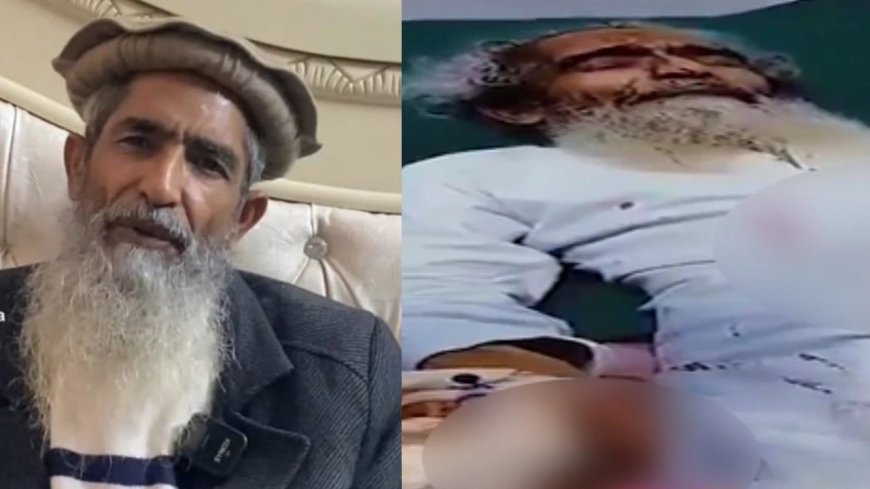
Lashkar-e-Taiba co-founder Amir Hamza injured in Lahore. Reports deny gunshot; domestic accident suspected. Hospitalized under ISI security.
 Utej
Utej
# LeT Co-Founder Amir Hamza Critically Injured in Lahore: Inside the Mystery That's Shaking Pakistan's Terror Network
Published: May 21, 2025 | Category: South Asia Security | Reading Time:~12 min
On the morning of Tuesday, May 20, 2025, a brief but explosive piece of news emerged from Lahore — Amir Hamza, the co-founder and chief ideologue of Lashkar-e-Taiba (LeT), one of the world's most dangerous and well-documented terrorist organisations, had been critically injured at his residence. Within hours, Pakistan's Inter-Services Intelligence (ISI) had placed him under tight security at a military hospital in Lahore, and the information blackout had begun.
The situation was initially marked by uncertainty, as early reports indicated that he had been shot, prompting speculation about a possible assassination attempt. Then came the reversal — Pakistani authorities and subsequent reporting confirmed there were no gunshot wounds. The injury, they said, was the result of a domestic accident.
But here is the problem. Nobody believes that. Not entirely. Not in the context of what has been happening to Lashkar-e-Taiba's leadership in recent weeks.
This is a story about a 66-year-old jihadist ideologue, a crumbling terror network, the shadowy world of Pakistan's security-terror nexus, and what these back-to-back incidents might mean for the future of one of South Asia's most feared militant organisations.
## Who Is Amir Hamza? A Man Who Built the Ideology of Terror
Before we dive into what happened on May 20, it is worth understanding exactly who Amir Hamza is — because he is not simply a figure in the background. He is the mind, the pen, and the theological scaffolding upon which Lashkar-e-Taiba built its entire justification for violence.
Born on May 10, 1959, in what is now Pakistan, Hamza came of age during one of the most consequential periods of modern South Asian history. The Soviet invasion of Afghanistan in 1979 drew a generation of young Pakistani men into the orbit of jihad, and Hamza was among them. He joined the Afghan mujahideen during the war against the Soviet Union, a campaign supported by both the United States and Pakistan. While the fighters succeeded in forcing Soviet troops to withdraw, the conflict also left behind networks and ideologies that would influence extremist movements around the world for decades.
When the Afghan jihad wound down, many fighters returned home with battle experience, weapons expertise, and an ideology that needed a new enemy. For Hamza and his associates, that enemy was India — specifically, the Indian state's presence in Jammu and Kashmir.
In 1987, Hamza became one of the 17 founding members of Lashkar-e-Taiba, a name that translates literally to "Army of the Pure." The group was founded under the umbrella of Markaz-ud-Dawa-wal-Irshad, a religio-political organisation established with significant backing from Pakistan's ISI and funding that, in its early days, included contributions channelled through American and Saudi sources during the Cold War anti-Soviet campaign.
But Hamza's role was never primarily military. He was the ideologue. He was the man who took the raw material of religious fervour and shaped it into structured theological justification for killing. His written works, most notably *Qafila Da'wat aur Shahadat* — translated as "Caravan of Proselytising and Martyrdom" — became foundational texts within LeT's training camps and recruitment pipelines. In these writings, Hamza articulated a worldview in which violent jihad was not merely permissible but obligatory, in which martyrdom was the highest spiritual achievement, and in which the enemies of Islam — defined broadly and conveniently to include India, the West, and anyone who stood in the way — deserved no mercy.
This kind of theological output matters more than most people realise. Organisations like LeT do not sustain themselves purely through coercion or money. They require a narrative — a story recruits tell themselves to justify what they do. Hamza supplied that narrative for nearly four decades. He was the reason young men from Pakistan's poorest districts could walk into a training camp and feel they were participating in something holy rather than something criminal.
He authored multiple jihadist texts, ran training programmes, gave speeches that were recorded and distributed, and served as a bridge between LeT's violent operations and its vast religious outreach infrastructure. This dual structure — mosque and massacre — was LeT's genius, and Hamza was central to maintaining it.
## Understanding the Incident: What Has Been Confirmed So Far
On May 20, 2025, Amir Hamza was found critically injured at his residence in Lahore. The details of what exactly happened remain murky, which is itself telling.
The initial wave of reporting, including from several Indian and Pakistani news outlets, suggested that Hamza had been shot — either by an unknown assailant who had gained access to his home, or as part of a broader targeted elimination campaign. This triggered immediate speculation about who might have been responsible: India's intelligence services, internal LeT rivals, or even elements within Pakistan's own security establishment carrying out a quiet housecleaning.
However, subsequent investigations and reporting — including from India Today NE — ruled out gunshot wounds. According to these accounts, the injuries were consistent with a domestic accident rather than an attack. Pakistani authorities, to the extent they have commented at all, have not contradicted this version of events.
And yet.
Hamza was not taken to an ordinary civilian hospital. He was admitted to a military hospital in Lahore, under ISI security — the same intelligence agency that has historically served as LeT's state patron, protector, and in many ways, its controller. The level of security reportedly in place at the hospital is described as exceptionally tight.
If this truly was a domestic accident — a fall, perhaps, or some other mishap — why the military hospital? Why the ISI detail? These are the questions that no official source has answered, and their silence is the loudest thing about this story.
There are several plausible explanations. The first is that Pakistan's security establishment, aware of what happened to LeT commander Abu Saifullah just days earlier(more on that shortly), is genuinely concerned that Hamza may be a target andis protecting him accordingly. The second is that the "domestic accident" story is a deliberate fiction intended to prevent panic within LeT's ranks or to avoid giving any adversary the satisfaction of knowing a hit was successful or attempted. The third — and this is where it gets uncomfortable — is that elements within Pakistan's own system may have had reasons to want Hamza neutralised, particularly in a period when Pakistan is under enormous international pressure to act against its own terror infrastructure.
We do not know which of these is true. We may never know. But the circumstances demand scepticism of any simple explanation.
## The Abu Saifullah Killing: Context That Changes Everything
To understand why Hamza's injury carries so much weight, you have to know what happened just days before.
Abu Saifullah, a senior LeT commander operating in Pakistan, was shot dead by unidentified assailants. He was not killed in a cross-border operation or an airstrike — he was killed inside Pakistan, presumably in relatively familiar surroundings, by people who apparently knew enough about his movements and location to reach him.
His assassination, coming just before Hamza's injury, has lit up the intelligence and security analyst community. The question everyone is asking: is there a pattern here?
There are a few frameworks through which to read these back-to-back events.
The internal purge theory: LeT, like all large militant organisations, is not monolithic. It has factions, ideological disagreements, financial disputes, and generational rifts. The old guard — men like Hamza who come from the Afghan jihad era — have not always aligned comfortably with newer leadership or with directions the organisation (and its ISI handlers) want to take. In the past, militant groups have periodically "cleaned house," removing figures who were becoming liabilities, too visible, or insufficiently controllable. Abu Saifullah's killing and the "accident" that befell Hamza could, under this theory, be part of a deliberate effort to retire or remove the older generation.
The external elimination theory: India's intelligence and security apparatus — including the Research and Analysis Wing (RAW) — has grown considerably more assertive in recent years. There have been credible reports of India targeting individuals it considers terrorist threats on Pakistani soil, something India has neither confirmed nor denied in any comprehensive way. Under this framework, the killing of Abu Saifullah and the attack (if it was an attack) on Hamza are connected operations by an external actor picking off LeT's leadership systematically.
The coincidence theory: Sometimes things just happen. Saifullah was killed in what might have been an entirely local or criminal matter unrelated to LeT's organisational structure, and Hamza genuinely slipped in his bathroom or fell down stairs. In a country as volatile as Pakistan, with as many armed actors as it has, violence against individuals — even militant figures — is not always geopolitically motivated.
Most serious analysts tend to discount pure coincidence when two senior figures from the same organisation are incapacitated within days of each other. The timing is simply too convenient to dismiss without more investigation.
## Jaish-e-Manqafa: The New Vehicle
One detail in this story that deserves more attention than it typically receives in breaking news coverage is the organisation Hamza founded in 2018: Jaish-e-Manqafa.
By 2018, LeT was facing unprecedented financial pressure. International sanctions — particularly those that followed the 2008 Mumbai attacks, which killed over 160 people and which the United Nations, India, the US, and the UK attributed directly to LeT — had been gradually tightening. The Financial Action Task Force (FATF) had placed Pakistan on its "grey list," and Pakistani banks were under pressure to stop facilitating transfers to organisations linked to terrorism. Hafiz Saeed, LeT's overall founder and leader, was placed under house arrest in moves that were widely seen as performative but nonetheless constrained certain operational freedoms.
In this environment, Hamza did what many veteran militants have done when their primary organisation comes under pressure: he created a new one. Jaish-e-Manqafa (loosely translated as "Army of the Negated" or with a more theologically loaded meaning related to Islamic jurisprudence) was framed as a religious organisation rather than an openly militant one. Its public face was preaching and proselytising. Its ideological DNA was entirely consistent with the jihadist worldview Hamza had spent thirty years developing.
The creation of Jaish-e-Manqafa is significant for several reasons. It demonstrates Hamza's resilience and continued relevance within the extremist ecosystem long after he might have been expected to fade into the background. It also shows the adaptability of Pakistan's extremist infrastructure — when one vessel comes under scrutiny, the contents are simply poured into another.
If Hamza's injuries are serious enough to sideline him permanently, the question becomes: what happens to Jaish-e-Manqafa? Who inherits the ideological franchise he has spent a lifetime building?
## Pakistan's Security-Terror Nexus: The Uncomfortable Truth
Any serious analysis of Amir Hamza's situation must grapple with the elephant in the room: the relationship between Pakistan's security establishment and organisations like LeT.
This relationship is not a secret. It has been documented by journalists, academics, think tanks, and foreign governments for decades. The ISI helped create LeT as a strategic asset — a force that could be deployed to bleed India in Kashmir while maintaining plausible deniability for the Pakistani state. In return, LeT received training support, intelligence sharing, safe houses, and crucially, protection from law enforcement action inside Pakistan.
This arrangement has always been fragile. When LeT carried out the 2008 Mumbai attacks — a spectacular, highly visible massacre that killed citizens from over a dozen countries and was planned and executed with a degree of professionalism that spoke to serious logistical support — the blowback was immense. Pakistan was forced, at least on paper, to act. Hafiz Saeed was periodically detained. Offices were occasionally raided. But the organisation's core infrastructure was never dismantled.
The reason is obvious to anyone who has studied the region. For elements within Pakistan's security establishment, groups like LeT serve a function that transcends any individual act of terrorism. They are instruments of regional policy. To destroy them entirely would be to give up a strategic tool that Pakistan's military has wielded since the 1980s.
But the world has changed. The FATF grey listing created real economic pain for Pakistan. Relations with China, while strong, come with their own demands for stability. The US, Pakistan's relationship with which has always been transactional, has grown less patient with what it sees as double-dealing on terrorism. And domestically, the Pakistani Taliban (TTP) has carried out devastating attacks inside Pakistan itself, creating a complicated situation where the state's tolerance of some militants while fighting others has become increasingly difficult to justify publicly.
In this environment, some figures within Pakistan's establishment may genuinely want to reduce the profile of organisations like LeT — not because they have had a moral awakening, but because the geopolitical calculus has shifted. Amir Hamza, as a veteran ideologue who has spent his career advocating for the kind of jihad Pakistan now officially disavows (even if unofficially supports), may have become more liability than asset.
## What This Means for the Region: India, Kashmir, and Beyond
The implications of instability at the top of LeT's leadership structure are significant, and they cut in multiple directions.
For India, particularly in the context of ongoing tensions over Kashmir and the broader bilateral relationship with Pakistan, the weakening of LeT's leadership could theoretically reduce the organisation's operational capability in the short term. Organisations that lose ideological leadership tend to fragment — some factions become more extreme and unpredictable, while others become less effective. Neither outcome is straightforwardly good news for regional stability.
For Kashmir specifically, LeT has historically been one of the most active external militant groups sponsoring infiltration across the Line of Control. Any disruption to its command structure could temporarily reduce such activity — but it could also push fighters who are no longer receiving coordinated direction into more autonomous and therefore less predictable action.
For Pakistan itself, the episode raises uncomfortable domestic questions. When figures like Amir Hamza — who have operated openly in Lahore for decades, writing books, founding organisations, and recruiting — can be hospitalised under mysterious circumstances without any public accountability, it underscores the degree to which Pakistan's militant ecosystem operates in a parallel legal universe where normal rules do not apply.
## The Information Blackout: Why Silence Speaks Volumes
As of the time of writing, there has been no official statement from Pakistani authorities about what happened to Amir Hamza. There has been no statement from LeT. There has been no confirmation of his current medical condition. Security at the military hospital remains exceptionally tight.
This silence is itself a kind of communication.
When states want to reassure the public that something was merely a domestic accident, they say so clearly and promptly. They produce medical reports. They allow family members to speak. They do not station intelligence operatives outside hospital rooms.
Pakistan's handling of this incident follows a familiar pattern: acknowledge just enough to prevent pure speculation, deny the most alarming version of events, and then go dark. It is the information management style of a state that has something to protect — whether that is the reputation of an old ally, the integrity of an ongoing investigation, or the details of an operation it would rather not explain.
## The Bigger Picture: A Terror Network Under Pressure
Step back from the specifics of Amir Hamza and what you see is a picture of Lashkar-e-Taiba under sustained pressure from multiple directions simultaneously.
International sanctions have constrained its finances. The FATF process has forced Pakistan to at least appear to crack down on certain financing channels. Hafiz Saeed, its highest-profile leader, has been in Pakistani custody since 2022. Now, within the space of one week, a senior commander has been assassinated and the organisation's chief ideologue has been hospitalised under circumstances that remain officially unexplained.
Organisations under this kind of simultaneous pressure do not simply dissolve. History suggests they adapt, splinter, or in some cases become more radical as moderate factions are eliminated and hardliners fill the void. The creation of organisations like Jaish-e-Manqafa is part of this adaptation — maintaining the ideological infrastructure while adjusting the visible shape of the organisation.
But there are limits to how much any organisation can absorb. If the people who provide the theological justification, the strategic direction, and the operational leadership are being removed — whether by external actors, internal rivals, or the Pakistani state itself — the question of what comes next becomes genuinely important.
## Conclusion:
The story of Amir Hamza's injury on May 20, 2025 is not, at its core, a story about one man's domestic accident. It is a window into the murky, violent, and consequential world that Pakistan has nurtured in its borderlands and cities for more than forty years — a world of ideologues and intelligence operatives, of state patronage and plausible deniability, of organisations that are simultaneously banned and tolerated, condemned internationally and protected domestically.
The questions this incident raises — who injured Hamza, why he is under ISI protection at a military hospital, what connection if any exists between his hospitalisation and Abu Saifullah's assassination, what it means for LeT's future — are not questions that Pakistani authorities appear eager to answer.
But they are questions that matter. Not just to intelligence analysts and South Asia policy specialists, but to every person in India, Pakistan, Afghanistan, and beyond who lives with the consequences of what organisations like Lashkar-e-Taiba have done and continue to represent.
An ideologue's fall — whether from a staircase or from something more sinister — does not end an ideology. It just forces it to find a new voice.